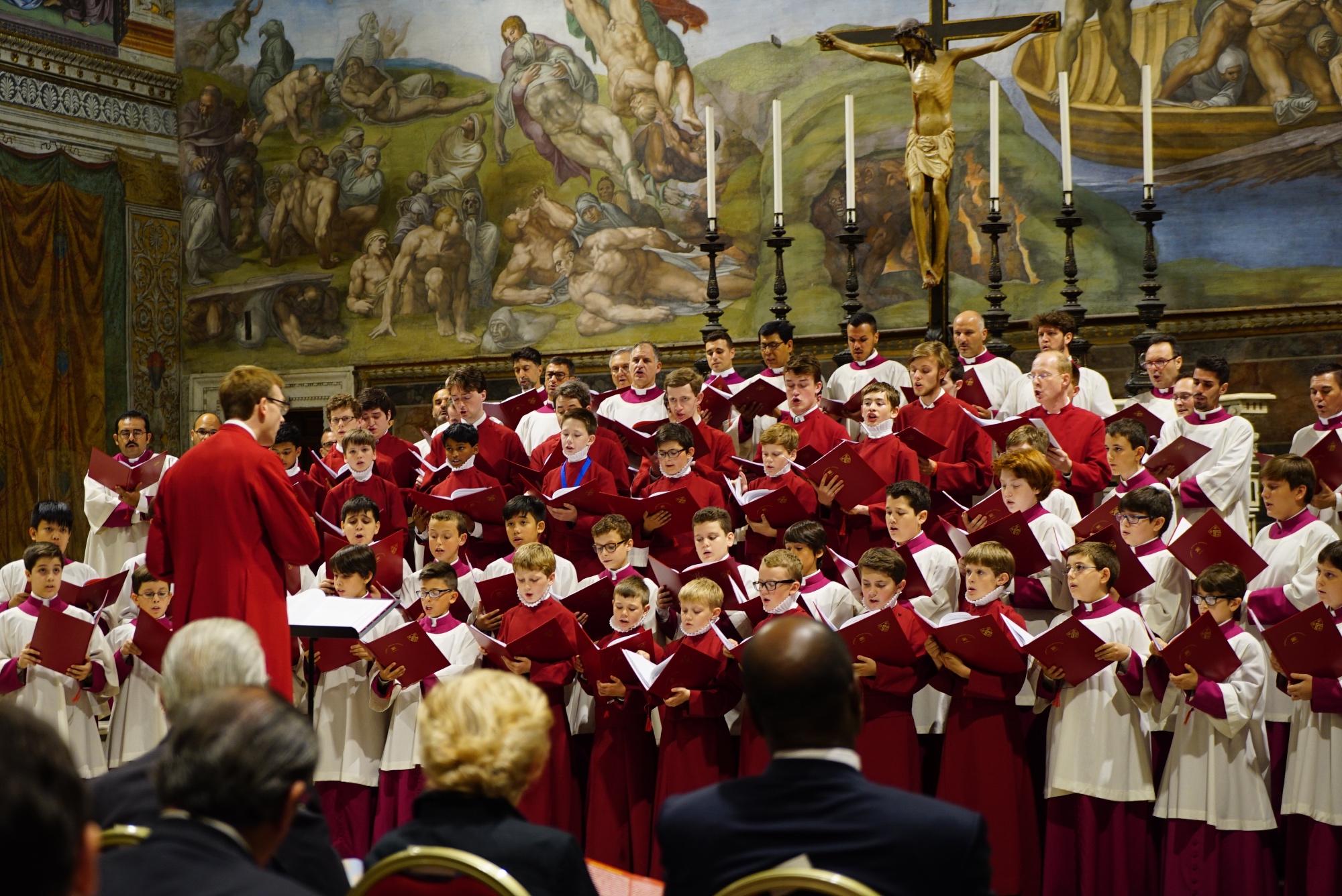
New College Choir
The full Chorister Handbook, including details about routines and safeguarding, can be found below via the drop-down menu headings.
When New College School was founded, William of Wykeham made provision for sixteen choristers to sing the daily services in the College chapel. Hence, the choir was the historical rationale for the School. The founder's provision retains its relevance in the twenty-first century, although the School now provides approximately twenty choristers, of whom four are probationers, with a further four or five who are pre-probationers. Today, in addition to singing the daily services during the University term, the choir has a full programme of recordings and concert tours in the UK and abroad.
You have not allowed cookies and this content may contain cookies.
If you would like to view this content please
New College Choir has an international reputation and the choristers receive an intense musical education. Nevertheless, a fundamental aim of both the School and the College is that there should be a balance between the boys' musical and academic lives. Choristers at New College lead busy lives, but they also participate in everything that a successful prep school has to offer. Choristers frequently manage to secure academic awards as well as music scholarships to their next schools. They also find time to play in, and to captain, football, hockey and cricket teams. The chorister routine at New College is also less demanding than that in many cathedrals: the boys are not required at Christmas or at Easter; nor do they sing on Sunday mornings.
At the same time, choristers must be fully committed to their music. They learn to sing to a professional standard by the age of twelve, and they also study two musical instruments: the piano and an orchestral instrument. The Choir's recordings and the concerts add a professional edge to their music-making. By the time a chorister leaves the School and the College, he has normally made about a dozen recordings, sung abroad on numerous occasions, and acquired a first-class musical and vocal technique.
You have not allowed cookies and this content may contain cookies.
If you would like to view this content please
Information about auditions, held each January for boys in school Year 2, can be found in the Chorister Handbook drop-down sections below. Further information can also be found at www.newcollegechoir.com or by contacting choir@new.ox.ac.uk.
You have not allowed cookies and this content may contain cookies.
If you would like to view this content please
Being a Chorister at New College
For a musical child, there is no better early training than choristership. But the choristers learn much more than music – the experience is of lifelong benefit, regardless of the path they take in their later studies and careers. They develop an understanding of teamwork, learning to take individual responsibility while working with others. They enjoy the thrill of performance to audiences at home and abroad, and retire (at thirteen!) with recordings of their singing that, in due course, they can play to their grandchildren. They reap the rewards of daily contact with a venerable tradition; something visible in the beauty of the chapel and college buildings, audible in music and words, and intangibly present in the spiritual import of their work. They hone skills of focus, calm under pressure, and learning from mistakes. And as they progress in the Choir, they pass all of this on, acting as mentors and guides to the younger choristers.
New College, New College Choir and New College School
In terms of foundation, legal standing and operational issues, there is no distinction between New College, New College Choir and New College School. It is best to think of the chapel and school as operating on the same campus, with just a short walk between the two. The team that looks after the choristers is employed by New College and there is frictionless contact and communication between its members to ensure consistency across the whole foundation, for the benefit of the choristers and their families.
The founder of New College, William of Wykeham, made provision for 16 boy choristers, alongside a number of clerks, to sing the daily offices (i.e. the morning and evening services in the chapel). That is still the default number of boys singing at services today. As in the 14th century, the Choir’s raison d’être is to provide the musical element of the College’s Christian worship, in its chapel, on a more or less daily basis during University terms. The College has been responsible for the education of its choristers since its foundation.
The musical training of a chorister, in the context of the boys’ safeguarding and wellbeing, is an indivisible educational process, shared by New College and New College School. The Organist and Headmaster hold formal weekly meetings (and communicate informally throughout the week) to ensure the smooth running of the operation, and to discuss the choristers’ progress and welfare. All staff who work with the choristers in school and chapel in regulated activity are, of course, subject to the requisite range of safeguarding checks and training. Those who are present, but not in regulated activity, are risk-assessed.
New College owns the NCS site and its buildings. NCS operates within the private sector, and is a member of IAPS (the Independent Association of Preparatory Schools) and CSA (the Choir Schools’ Association). The Governing Body of the School, comprising a number of College Fellows and external appointees, is chaired by the Warden of New College. The choristers (including probationers) represent about a sixth of the School’s intake. The day-to-day management of the choristers’ routine is handled by the Headmaster and the Organist. The choristers’ day is carefully integrated between New College and NCS.
Overall responsibility for the Choir’s musical direction, administration and welfare lies with the Organist, Robert Quinney. He is a Fellow of New College, with teaching responsibilities both in College and in the Faculty of Music, but has in fact spent his whole career working with choirs like New College’s. He is assisted by the Assistant Organist, and one or more Organ Scholars, who are undergraduate members of the College. The administration of the Choir is undertaken by the Choir Administrator.
Among the School staff are two Chorister Tutors who, with the Headmaster, oversee and supervise logistical and pastoral arrangements for the choristers. The Headmaster and Chorister Tutors accompany the Choir on tours. The Director of Music at NCS has overall charge of the musical activities there, teaching class music, giving piano lessons, running the school’s chamber choir, and supervising the visiting instrumental teachers. He is responsible for the organisation of Oxford Children’s Chamber Orchestra (OCCO), during which musicians at the school, from Year 5 upwards, receive theory and composition lessons, and engage in ensemble and orchestral activities.
New College subsidises chorister places at New College School, reducing the fees paid by chorister parents by around two-thirds. Current figures are available from the ‘fees’ page at www.newcollegeschool.org. Further chorister bursaries may be available in cases of need.
Inevitably the Choir’s repertoire has developed over the last six and a half centuries; it now encompasses all styles of music from the early 16th century to the present day (stretching further back, if you count the Gregorian Chant we use for some psalms and at the Eucharist). Perhaps the most notable change in the Choir’s activities is the work we do beyond the walls of the college: we broadcast on radio and the internet; we record, usually at least once a year; and we undertake concert tours outside the UK. New College Choir is internationally recognised as a leader in its field.
The Chorister Schedule
The basic weekly routine is outlined below. Note how the first two years grow in intensity toward the full immersion of Years 5–8. This timetable is for University term only. Services usually begin on Friday of the week before full term begins (known as ‘0th week’), and continue until the Sunday immediately following 8th week. Commitments outside term are detailed on the termly Choir Diary and are also communicated via the ‘TeamUp’ app. University term dates may be found online (www.ox.ac.uk/about/facts-and-figures/dates-of-term).
Outside University term, but when New College School is still in term, the boys continue to rehearse twice a day on Monday, Tuesday, Thursday and Friday (pick-up is earlier than in term, because of the absence of services), but are otherwise free of choir commitments.
Services are always preceded by a rehearsal. Services begin at 6.15pm (5.45pm on weekends), and are usually finished by 7pm. Unusually for a choir of this sort, there is no regular Sunday morning commitment.
The Schedule of events at which the boys sing is kept updated on a diary platform shared with all connected with the choir, TeamUp: https://teamup.com/kspn1a772kbjxb2e7c . In addition, a Master Timetable document summarizing services out of the ordinary pattern and containing all information about the Choir in one place is circulated to parents in advance of each term and as and when major changes are made. This is not designed to replace TeamUp but to provide an overview. Whenever significant changes are made to the diary, chorister parents will be alerted via ParentMail, especially re items marked as TBC or Details TBC.
The usual pattern of singing for boys in Years 5-8 is summarized in the table below:
|
UNIVERSITY TERM |
OUTSIDE UNIVERSITY TERM but during SCHOOL TERM |
||
|
Monday |
|
Monday |
|
|
1200-1300 |
Rehearsal in Chapel |
1200-1300 |
Rehearsal in Chapel or Clore Studios |
|
1600-1645 |
Rehearsal in Chapel |
1600-1645 |
Rehearsal in Chapel or Clore Studios |
|
1645-1700 |
Collection from S Undercroft |
1645-1700 |
Collection from NCS |
|
|
|
|
|
|
Tuesday |
|
Tuesday |
|
|
1200-1300 |
Rehearsal in Chapel |
1200-1300 |
Rehearsal in Chapel or Clore Studios |
|
1630 |
Tea in College |
1600-1645 |
Rehearsal in Chapel or Clore Studios |
|
1700-1800 |
Rehearsal in Chapel |
1645-1700 |
Collection from NCS |
|
1815 |
Evensong in Chapel |
|
|
|
1855-1910 |
Collection from S Undercroft |
|
|
|
|
|
|
|
|
Wednesday |
|
Wednesday |
|
|
No chorister rehearsals Exceptionally BBC Radio 3 Evensong |
No chorister rehearsals |
||
|
|
|
|
|
|
Thursday |
|
Thursday |
|
|
1200-1300 |
Rehearsal in Chapel |
1200-1300 |
Rehearsal in Chapel or Clore Studios |
|
1630 |
Tea in College |
1600-1645 |
Rehearsal in Chapel or Clore Studios |
|
1700-1800 |
Rehearsal in Chapel |
1645-1700 |
Collection from NCS |
|
1815 |
Vespers or Evensong in chapel |
|
|
|
1855-1910 |
Collection from S Undercroft |
|
|
|
Vespers (even weeks) & Evensong will alternate
|
|
|
|
|
Friday |
|
Friday |
|
|
1200-1300 |
Rehearsal in Chapel |
1200-1300 |
Rehearsal in Chapel or Clore Studios |
|
1630 |
Tea in College |
1600-1645 |
Rehearsal in Chapel or Clore Studios |
|
1700-1800 |
Rehearsal in Chapel |
1645-1700 |
Collection from NCS |
|
1815 |
Evensong in Chapel |
|
|
|
1900 |
Rehearsal in Chapel/ Parents’ drinks in S Undercroft |
|
|
|
1920 |
Collection from S Undercroft |
|
|
|
|
|
|
|
|
Saturday |
|
Saturday |
|
|
1520 |
Drop off at PORTERS’ LODGE |
No services. Occasional extra rehearsals for special projects, such as concerts or recordings. See EXTRA EVENTS |
|
|
1530 1615 |
Rehearsal in Chapel Tea in college |
||
|
1645-1730 1745 |
Rehearsal in Chapel Evensong in Chapel |
||
|
|
Or Sung Eucharist |
||
|
1830-1840 |
Collection from S Undercroft |
||
|
|
(depending on service length)
|
||
|
Sunday |
|
Sunday |
|
|
1620 |
Drop off at PORTERS’ LODGE |
No services. Occasional extra rehearsals for special projects, such as concerts or recordings. See EXTRA EVENTS |
|
|
1630-1730 |
Rehearsal in chapel |
||
|
1745 |
Evensong in chapel |
||
|
1845-1855 |
Collection from S Undercroft |
||
|
|
(depending on service length)
|
|
|
The pattern for half-term holidays and holidays generally is:
|
HALF TERM usual schedule |
|
||
|
First weekend |
NO commitments |
|
|
|
Weekdays |
NO commitments |
|
|
|
Second weekend |
|
|
|
|
Saturday |
|
|
|
|
1520 |
Drop off at PORTERS’ LODGE |
|
|
|
1530 |
Rehearsal in chapel |
|
|
|
1615 |
Tea in college |
|
|
|
1645-1730 |
Rehearsal in chapel |
|
|
|
1745 |
Evensong in chapel |
|
|
|
1830-1840 |
Collection from S Undercroft |
Services usually begin on the Friday immediately preceding the first Sunday of University term (known as ‘Friday of 0th Week’), and finish on the Sunday after the last day of term (Sunday of 9th Week). |
|
|
|
(depending on service length) |
||
|
|
|
||
|
Sunday |
|
||
|
1620 |
Drop off at PORTERS’ LODGE |
||
|
1630-1730 |
Rehearsal in chapel |
For full dates to 2032 see |
|
|
1745 |
Evensong in chapel |
||
|
1845-1855 |
Collection from S Undercroft |
||
|
|
(depending on service length) |
|
|
On weekdays, the choristers are given a substantial tea in the College Hall before the rehearsal and service, and homework is supervised at NCS by Chorister Tutors.
For weekend services, parents drop off and pick up their sons in College; otherwise. For weekday services, the choristers are accompanied to College at the end of the school day by Chorister Tutors; they are then picked up from College by parents, usually between 6.50 and 7.00pm.
Concerts, Recordings and Tours
There is no regular schedule of concerts, recordings and tours, but we expect to travel outside the UK at least once a year, and to record once or twice in the same period. In recent years the Choir has travelled to the USA, Australia, and most European countries, giving concerts by itself and with other ensembles, vocal and instrumental. All this is of considerable educational value to the choristers, both musically and socially. At the same time, they are helping to promote on an international level the excellence of their work in Oxford, bringing this important piece of the UK’s cultural legacy to a wider audience, acting as ambassadors for the country as well as for New College. While on tour, boys are given sufficient time to recover from travel before rehearsing or performing, and we take every opportunity to explore the places we visit. With the exception of small incidental costs like spending money, the costs of the Choir’s touring are not passed on to chorister parents.
Most of the touring and recording undertaken by the Choir takes place in holiday periods. During a typical year the boys are likely to be engaged in such activities for periods totalling four to six weeks. Notice of the Choir’s commitments is given in good time, allowing parents to organise their family holidays around the Choir’s work. A very small number of events may cut into the NCS term, since it is impossible to organise everything to fall into the school holidays. The periods immediately following the end of term are likely to be busiest with outside work; the month of August is usually free of choir commitments.
Auditions
We audition boys in Year 2 (usually just after Christmas), when they are rising 7 years old, for entry to NCS in Year 3. We welcome candidates who are already in the NCS pre-prep, as well as those who are not yet at the school.
The auditions are friendly and low-key occasions, arranged and held by members of the team who have a lot of experience of putting young children at ease. The Organist and the NCS Director of Music will hear a short vocal solo; for example, a hymn or Christmas carol, or even a nursery rhyme. Lengthy songs should be avoided; so should ‘music theatre’ pieces (i.e. songs from musicals or films), as they tend to lock a young voice in the lowest part of its range, inhibiting access to the upper register. As well as the prepared piece, your son will be asked to respond to a variety of ear tests (e.g. singing back notes played on the piano).
Candidates may also wish to play an instrumental piece, but this is not essential; though all choristers learn at least one instrument, some have not begun lessons at the time of their audition, and this does not prejudice their chances – we are looking for potential more than polish at this stage.
In terms of preparation, all we ask is that parents make sure the boys knows the tune and words of their pieces, and describe to them what will happen (see above). But please don’t over-prepare. The audition is designed to be a friendly, enjoyable experience; we set boys at their ease, allowing them to reveal their potential as choristers. If a boy feels under pressure, it is difficult for him to perform to the best of his ability; but in no circumstances will we make a boy feel uncomfortable.
In addition to the musical audition, candidates sit the entrance assessments for NCS, which are carried out under the supervision of the NCS Registrar, Headmaster and their colleagues. Candidates are asked to write creatively to a given title, read and answer some written comprehension questions; take a mathematics test comprising problems using addition, subtraction, multiplication and division; and sit on-line reading and mathematics reasoning tests. The result of auditions is usually communicated to parents by email within a week of the audition date.
Balancing Life as a Chorister
The choristers lead busy lives, and develop, with help from their teachers and parents, effective strategies for fitting schoolwork, instrument practice and other activities in among their choir commitments. On weekdays when they sing a service (Tuesday, Thursday and Friday), the choristers have time to work on their prep (as well as time to relax and play) between the end of the school day and chorister tea. The absence of a Sunday morning commitment, and the relatively short University terms, also allow more time for other activities than do many choristerships. We believe the rewards offer ample return on the undoubted investment of time.
The staff at NCS know when the choristers are under particular pressure from their Choir commitments (as for instance when they have a concert to fit in with their normal routine), and plan accordingly. There is a standing item regarding chorister welfare and commitments in the school’s weekly staff meetings, so all members of school staff are kept informed of the chorister schedule and know to calibrate their expectations accordingly. The skills the choristers develop, which depend upon a capacity for focused listening and application, no doubt stand them in excellent stead academically, both at NCS and beyond. Over the years, choristers have regularly achieved either an academic and/or a musical award to their chosen senior school.
Choristers are selected for the school teams and play as a matter of course. When fixtures clash with the chorister routine the Organist is thoughtful about excusing boys their chorister duties, while taking into account that there are certain times in the term when musical considerations need to be paramount.
Most choristers learn two instruments, but instrumental study is arranged to suit the needs of the individual. Piano study is a vital part of a boy’s developing musical literacy, so all choristers have piano lessons. The study of an orchestral instrument gives access to ensemble playing and its attendant musical and social benefits. If learning two instruments on top of singing appears to be ambitious, it is worth remembering thatthe musical skills developed in the Choir are entirely complementary to instrumental study. The chorister age-span is an ideal time for laying the foundation of good technique, allowing for real accomplishment to be developed in due course. Associated Board examinations are taken when appropriate and instrumental practice time for choristers can be arranged before school. There are some funds to assist with instrumental tuition fees in the case of need.
Instrumental music-making provides a bridge from the Choir to a chorister’s next school, the considerable gap left by the end of chorister life filled by new possibilities for advancing on his instruments. Senior independent schools are often prepared to invest heavily in boys with a chorister background, particularly when their expertise extends to two instruments. In recent years leaving choristers have won valuable Music Scholarships, and in many cases these provided the means by which they have continued their secondary education within the independent sector.
The Probationary Period
We do not select more choristers than the available places and bursaries. Great care is taken during the selection process to evaluate the potential of a boy as reliably as possible. In very rare cases, a boy’s progress in his probationary years may be judged to bring his future as a fully fledged chorister into question. This would be the result of constant informal assessment and discussion between the Organist, Headmaster and their colleagues; no decision hangs on a single test. Both the Organist and Headmaster keep in close contact with parents, especially in cases of inconsistent or unusually slow development, or if there are pastoral concerns.
Very occasionally a boy will find the experience uncongenial and want to leave. Here again, it is better to have sorted out his interests and preferences at an earlier stage. And it is important to bear in mind that the ‘chorister experience’ reaches its most enjoyable phase in the final two years, since the senior choristers are the most experienced and confident.
Once past the probationary phase, a chorister’s place is confirmed on the understanding that he will commit the following four years to the Choir. The Choir depends on this mutual commitment. The worst of all scenarios is to have invested two years in a boy’s training and then not to benefit from the investment. For the College a chorister place represents a considerable investment of both human and financial resources, and once a boy is a full chorister, the interests of the Choir as an institution – and as a team – have to be paramount. Because of this, the parent contract stipulates that the parents of any chorister who leaves the Choir against the opinion and wishes of the Organist and Headmaster, will then be liable to repay the College’s fee subsidy which their son has hitherto enjoyed. But it must be said that once admitted, every boy turns out to be a useful member of the Choir, and many achieve exceptional standards, often well beyond what they (and indeed their parents) imagined possible.
Years 3 and 4 Probationer Routine:
Year 3 choristers in waiting follow the normal school day but in addition undertake singing and other musical training to prepare them for the requirements of choristership. In 2026-2027 they will have singing lessons in school on:
Mondays 08:20 – 08:50 in NCS with Asst Organist / Organ Scholar
Tuesdays 16:00 - 16:30 in NCS with Singing Teacher (during University Terms)
Fridays 08:20 – 08:50 in NCS with Asst Organist / Organ Scholar
The commitments for Year 4 choristers increase as the year progresses as per the table below:
|
|
Michaelmas |
Hilary |
Trinity |
|
Monday |
Lunchtime rehearsal Afternoon rehearsal |
Lunchtime rehearsal Afternoon rehearsal |
Lunchtime rehearsal Afternoon rehearsal |
|
Tuesday |
Lunchtime rehearsal Afternoon rehearsal [& Evensong in University term] |
Lunchtime rehearsal Afternoon rehearsal & Evensong |
Lunchtime rehearsal Afternoon rehearsal & Evensong |
|
Wednesday |
No commitments |
No commitments |
No commitments |
|
Thursday |
Lunchtime rehearsal only |
Lunchtime rehearsal Afternoon rehearsal & Evensong |
Lunchtime rehearsal Afternoon rehearsal & Evensong |
|
Friday |
No commitments |
No commitments |
Lunchtime rehearsal Afternoon rehearsal & Evensong |
|
Saturday |
No commitments |
No commitments |
No commitments |
|
Sunday |
Attend Evensong (in congregation with MJT or PAR); Drop off at Porters’ Lodge at 17:25; Collect from Song Room after service |
Before Half-Term: Evensong in congregation After Half-Term (mostly) Afternoon rehearsal & Evensong |
Afternoon rehearsal & Evensong |
Who’s Who
The Warden – the overall head of New College who oversees the College, the Chapel and Choir, and as Chair of Governors of NCS chairs the Governing Committee which oversees the school and its choristers.
The Organist – is responsible for the musical direction and excellence of New College Choir and has most direct oversight of the wellbeing of the choristers during rehearsals, concerts and tours. He shares this oversight with the Headmaster, Chorister Tutors and Assistant Organist, liaising frequently and regularly with key members of staff. In particular, the Organist and Headmaster meet formally at least once a week (especially during university term), and liaise much more frequently informally on an ad hoc basis.
The Headmaster – is responsible for the effective day-to-day running of NCS and has oversight of the wellbeing and safeguarding of all its pupils, including the choristers. He liaises frequently and regularly with all other key members of staff.
The Dean of Divinity – runs New College Chapel and has spiritual oversight of the New College Chapel community, taking services and liaising frequently and regularly with the Organist and Headmaster over issues pertaining to the Choir and its choristers.
The NCS Director of Music – Oversees all matters pertaining to NCS music, including the musical life of the choristers as it pertains to school music (e.g. instrumental lessons and progress).
The NCS Asst Director of Music – Assists the NCS Director of Music above, and has especial oversight of the probationer choristers’ music theory training.
The Chorister Tutors – have two primary functions:
Pastoral: the CTs keep a close eye on the wellbeing of all the choristers, being the first port of call for any issues to do with that wellbeing. They work to ensure that there is harmony among the choristers, that their concerns (and those of their parents) are listened to and acted upon. They also act as the choristers’ voice with other colleagues, for example to flag up any issues of concern or times when the choristers’ workload may have an effect on their performance in other parts of the school.
Logistical: the CTs ensure that the choristers are in the right place at the right time, with the right kit. This entails tight timings to ensure that rehearsals begin and end promptly and choristers get their requisite rest/play time. This applies in school and also on tour and during extra rehearsals and concerts. CTs keep a close eye on the schedule sent out by the Choir Administrator (available on the TeamUp choir calendar), which includes concerts and other events that are in addition to the weekly routine.
The Assistant Organist – works closely with the Organist, Headmaster and Chorister Tutors, deputising for the Organist in his absence (e.g. in rehearsals and services). He also assists in chorister logistics, for example accompanying choristers as they move between school and chapel. He also teaches probationer choristers, as well as choristers in Years 5-8 in ‘break-out groups’, as well as helps with logistics during concerts and tours.
The Organ Scholars – assist the Assistant Organist in accompanying choristers as they move between school and chapel. On very rare occasions, as part of their training they might lead a rehearsal and/or service. They also assist in the teaching of probationer choristers.
The Choir Administrator – oversees the logistical day-to-day running of the Choir, liaising with the Organist and Headmaster regarding schedules and the logistics of concerts/tours (e.g. travel and accommodation arrangements). He also deals with issues like parking.
Academic Clerks – sing in New College Choir during their studies at New College.
Lay Clerks – sing in New College Choir as paid professionals.
‘Deps’ – are those who are brought in to deputise for clerks who are unable to sing in a particular service. When in regulated activity, these deps undergo Safer Recruitment checks; when not in regulated activity, they are risk assessed and their attendance monitored by the Choir Administrator and Headmaster to ensure they do not end up in regulated activity.
The Associate Chaplain – assists the Dean of Divinity in the above.
Vergers – oversee the logistics of services in New College Chapel, liaising with visitors and maintaining security.
Safeguarding Choristers
As pupils of New College School, the choristers come under the detailed safeguarding arrangements as outlined in the NCS Safeguarding Policy, which is updated at least annually and is easily available via the ‘Contract and Policies’ page at www.newcollegeschool.org. There are issues and arrangements specific to the chorister experience which require additional attention. The safeguarding of choristers is the responsibility of everyone working in and around New College School, Choir and Chapel: the Headmaster, NCS Governors, Chorister Tutors, Organist, Assistant Organist, Organ Scholars, Lay Clerks, Academical Clerks, Dean of Divinity, Associate Chaplain, Vergers, Choir and Chapel Administrators, and anyone whatsoever who has the opportunity for contact with the choristers, or observes them. There should never be the assumption that ‘someone else will do it’. The Headmaster of NCS and Organist meet formally once a week during school term to discuss the wellbeing and safeguarding of choristers, including going through issues concerning each chorister individually, and monitoring the choristers’ workload to make appropriate adjustments; they also liaise much more frequently informally.
All of those who fall into ‘Regulated Activity’ (see below) in the Choir and/or Chapel must have the usual safeguarding pre-appointment checks before they begin their work with opportunity for access to the choristers. The Organist and Dean of Divinity are Safer Recruitment trained to ensure that any appointments in the Choir or Chapel follow the correct recruitment procedures. They work with the Choir and Chapel administrators, and the administrators in the NCS Office, to ensure that the appropriate procedures and checks are carried out, and that those in regulated activity are stored on the NCS Single Central Register, which is overseen by the NCS Office, the Headmaster, and the NCS Safeguarding Governor.
There may be some individuals (e.g. deps, dep vergers and the like) whose work does not constitute ‘Regulated Activity’, but it may become ‘Regulated Activity’ if the frequency of their presence in the Choir/Chapel increases. ‘Regulated Activity’ is work that a barred person must not do. In relation to children this comprises regular work in schools with opportunity for contact with children. ‘Regular’ includes ‘frequent’ and these are defined together as: once a week or more often; or on 4 or more days in a 30-week period; or overnight (between 2am and 6am).
When a Choir dep is required, the clerk who requires the dep should inform the Choir Administrator in good time of the name of the dep who is deputising. Again, safeguarding is everyone’s responsibility and if a clerk arranges for a dep who has not been risk assessed, or who has not had the requisite safeguarding checks, they are putting the safety and wellbeing of the choristers at risk. Once informed by a clerk of a proposed dep, the Choir Administrator then carries out a risk assessment which is communicated to the NCS Headmaster/Office so there is oversight to ensure that a dep without full safeguarding checks does not fall into ‘Regulated Activity’. This risk assessment is stored in the NCS Office so there is oversight of the frequency of a dep’s presence with opportunity for access to children. A core list of deps who have undergone full pre-appointment safeguarding checks is available and these deps can be used without these restrictions, and without the need for there to be a separate risk assessment. The same situation pertains to deputising vergers. The verger who is being deputised should inform the Chaplain/Chapel Administrator and they should inform the NCS Headmaster/Office, with a risk assessment completed to ensure that the dep verger does not fall into ‘Regulated Activity’.
During services, supervision is carried out benignly by all members of Choir and School staff present, but the most direct supervision during services is by the Headmaster or Chorister Tutor on duty. They sit in close proximity to the Organist for easy and timely communication should there be a concern about a chorister’s welfare. Those on duty have First Aid training. The Organist, Assistant Organist, Organ Scholars, Choir Administrator and Chorister Tutors all have full Paediatric First Aid training. It is best practice not to be alone with a lone chorister, so once the initial emergency has been seen to (usually a medical one), the adult on duty should either ensure there is a second adult present in the Song Room or vestry, or take the chorister to the more public area of the antechapel where they can sit at the side while the adult on duty can keep a benign eye on the rest of the choristers during the service. There is a unicameral toilet available directly opposite the Antechapel door, should the chorister need to use the facilities.
Musical Excellence and Child Welfare
Staff involved in the Choir of New College and at New College School recognise that there can be a tension between musical excellence and child welfare. The Headmaster and Organist meet formally each week to discuss the choir’s schedule, in the context of the children’s other school commitments. Each chorister is discussed individually to ensure that there is consistency and awareness across both school and choir. When appropriate, especially during busy times of the year, mitigations are put in place to help support the children’s workload. Reasonable adjustments are also put in place for individuals who would qualify and benefit from those adjustments or extra areas of support. There is a standing item in the school’s weekly staff meetings, during which the chorister tutors keep all school staff abreast of issues pertaining to choristers, notably any pastoral issues or particular periods of increased activity in the choir context. This information is then circulated to all NCS staff via the meeting’s minutes.
During rehearsals and services/performances, the children are well supported with an appropriate extra adult in attendance who can, at little to no notice, attend to a chorister who has a medical issue or is in distress. Choristers are aware of when it is appropriate to leave a rehearsal, service or performance, and they are familiar with the adults who will be looking after them in an emergency (usually a chorister tutor, the Headmaster, the Assistant Organist, Organist or an Organ Scholar).
Contemporary behaviour management strategies are promoted in the choir and school context, with relevant personnel (especially those at the beginning of their careers) attending training courses and/or liaising with the Headmaster and NCS staff about effective positive discipline.
The Voice of the Chorister and the Chorister Parent
There are many mechanisms through which the choristers, and their parents, can give feedback on the chorister experience. All members of NCS and New College Choir staff, especially the Headmaster and Organist, are accessible and very happy to discuss any concerns choristers and their parents may have, as well as any suggestions to improve the chorister experience. This may be at drop-off or pick-up, or in a special meeting requested by choristers/parents. If choristers and/or their parents wish to give feedback, or raise concerns, anonymously they can do so in a number of ways: through the regular NCS community surveys, through the ‘suggestions box’ outside the Headmaster’s study, or through the ‘Contact Us Anonymously’ box on the NCS website, which sends an anonymous message straight to the Designated Safeguarding Lead (DSL).
In addition, the Chorister Tutors have regular check-ins with the choristers, based around the following ‘Chorister Check-In’ questions:
Generally:
1. What do you think are the positives and enjoyable aspects of being a New College chorister?
2. How could your experience of being a New College chorister be made even better?
3. Who would you speak to if you had any concerns or worries related to your life as a chorister?
4. Are your teachers understanding about the demands of being a chorister when it comes to your work in school (for example, are they understanding if you are unable to complete preps)?
5. Do you have any comments or observations you would like to make about the balance between your schoolwork and your life as a chorister?
6. Do the choristers in other year groups (especially those older than you) help and support you?
When in New College:
1. Who do you think is in charge of your safety and wellbeing when you are in New College?
2. When you are in New College, which adults could you speak to if you had any worries or concerns?
3. Do you feel safe and well looked-after when you are rehearsing and performing in New College Chapel (including the Song Room)?
4. Do you feel safe and well looked-after when you are in New College but not rehearsing and performing (for example, during mealtimes or rest/recreation periods)?
5. Do you feel safe and well looked-after at special evening events that are not services or concerts in the Chapel (for example, when singing at dinners in the hall)?
6. What would you do if you became injured or unwell during a service or other performance in New College and who do you think would look after you?
7. In which circumstances do you think it would be ok for the choir to stop singing and to leave the chapel?
8. What would you do if there was an emergency (for example, if the fire alarm went off) in chapel?
When away from New College (for example, when on tour internationally, or performing in the UK but at other venues):
1. Who do you think is in charge of your safety and wellbeing when you are away from NCS and New College (for example, when you are on tour)?
2. When you are on tour or at a concert away from New College, which adults could you speak to if you had any worries or concerns?
3. Do you feel safe and well looked-after when you are travelling for concerts or tours (for example, in airports, on planes, on buses)?
4. Do you feel safe and well looked-after when you are rehearsing and performing in venues away from New College?
5. Do you feel safe and well looked-after when you are staying overnight in hotels or the equivalent when on tour?
6. Do you feel safe and well looked-after during rest/recreation periods when on tour?
7. What would you do if you became injured or unwell during a service or other performance on tour and who do you think would look after you?
8. What would you do if there was an emergency (for example, if the fire alarm went off) at a venue when you were on tour?
Is there anything else you would like to say, or that you would like us to know?Safeguarding during Tours and Concerts
The Headmaster, Chorister Tutors, Organist and Assistant Organist are all responsible for the pastoral wellbeing and logistical concerns of choristers when they are away from NC/NCS. This includes ensuring safety during travel (e.g. ensuring seatbelts worn), wellbeing during that travel (e.g. ensuring travel sickness tablets taken in advance), and making sure that the boys are in the right place at the right time, wearing the right things and carrying the right music. They have responsibility for carrying and administering any medication for the choristers, once they have written permission from the chorister parent, specifying dosage and timing of said medication.
There are well-established routines for hotel stays. The boys must stay in pairs (at a minimum), with all rooms and rooms of chaperones on the same hotel floor. The chaperones’ rooms must have a post-it note on their doors notifying the boys where the chaperones are present and it is often a good idea to place post-its on the boys’ doors (with initials rather than full names) making clear to the chaperones where each of the boys is. When the boys are in their rooms, they must not leave those rooms unless they have been told to, or in an emergency. They must place a shoe in their door to enable easy communication while still ensuring the boys’ privacy. While those shoes are in the door, the CTs/Headmaster/Organist/Asst Organist must be present in the corridor.
The CTs/Headmaster/Organist/Asst Organist stay in the corridor once the boys have gone to bed until the boys are asleep, at which point the doors are closed. CTs/Headmaster/Organist/Asst Organist must be available in an emergency during the night and, if a chorister does need assistance, for the CTs/Headmaster/Organist/Asst Organist’s protection it is recommended that another adult is woken so there are two adults present to help deal with the issue. In the very unlikely event that a chorister needs to be taken to the hospital for medical attention, they should be accompanied by two members of staff out of the Chorister Tutors, Headmaster, Organist, Assistant Organist, and Organ Scholars. At least one of these should be from the school. The remainder of the choristers should be supervised by at least two members of the staff who remain. Frequent contact should be kept between the staff in the different locations.
There may be occasions when choristers dine in locations where members of the public are present: either when ‘at home’ in New College or on tour. On all occasions, the choristers are directly supervised by at least two members of School or Choir staff. There is no need for any interaction between choristers and members of the public, beyond brief pleasantries (for example after a concert when often members of the public wish to congratulate the choristers). Again, any such interactions are supervised.
There are rest periods built in to the concert days to ensure the boys are prepared for their evening concert. It is vital that the boys rest during these periods and CTs should treat those periods as if the boys are going to bed at night (lights out, curtains drawn etc.). On tours the CTs are responsible for keeping an eye on the boys’ healthy nutrition. During concerts, the CTs sit in allocated seats close to the boys and they are present to assist the boys should they be taken ill during a concert. After the concert, the CTs coordinate the boys’ packing away of cassocks, ruffs, music etc. and returning to transport/hotel in a safe and timely fashion.
The ‘Crisis Kit’ is a red rucksack that ordinarily lives in the Song Room in New College, adjacent to New College Chapel. It has in it a full First Aid kit and other medical necessities (sick bags etc) as well as contact details of all chorister parents. This kit must also be with the choristers wherever they go when not in College but on a choir event, e.g. domestic concerts, tours. This includes all moments on tours like breakfast/lunch/dinner/excursions. The kit is updated regularly, with the First Aid kit checked in liaison with the NCS office.
While we enjoy pleasant and convivial relations between all members of the choir, CTs should keep an eye out for inappropriate interactions between the adults in the back row in the choir and the choristers. Polite conversation is fine, but CTs should ensure that the boys do not ‘attach’ themselves to any members of the back row, nor that any members of the back row pursue a ‘friendship’ with any of the boys. On tours, especially, aside from some travel (e.g. flights, bus journeys) the boys and the adults of the choir remain distinct constituencies. This is also covered in the Choir’s Code of Conduct for all adults in New College Chapel and Choir, and must be followed punctiliously. If there are any concerns whatsoever, the usual child protection avenues must be followed.
Code of Conduct for All Adults in New College Chapel and Choir
The Code of Conduct must be read in conjunction with the NCS Safeguarding Policy and the NCS Safer Working Practices Policy. The following Code does not replace these but seeks to capture their essence in an accessible and summary form.
It is everyone’s responsibility to safeguard and promote the welfare of children and young people.
Adults must always treat Choristers courteously, but should not cultivate their acquaintance. Choristers should, if they have need, refer to Adults as Mr/ Miss so-and-so.
Given the above, it is perhaps less likely that a Chorister will tell an Adult in the Chapel or Choir about a child protection matter than one of their teachers, but if they do, the responsibility remains the same:
- Always stop and listen seriously;
- Reassure the Child;
- Empathise but do not ask questions;
- Do not promise not to tell anyone;
- Do not view forward any images or content that could potentially be illegal.
Contact the DSL, as soon as possible or in his absence the Deputy DSL, or the Headmaster. Full contact details are made readily available via posters in prominent areas in New College chapel, the vestries and Song Room.
Adults should not:
- be alone in a room with a child unless it is for teaching purposes and there is an open or glazed door in an area where there are plenty of passing adults;
- touch children and corporal punishment of any description is prohibited;
- photograph the Choristers unless it is in accordance with the school’s policy on the use of mobile phones and cameras;
- invite a child alone into their domestic accommodation or offer them a lift in their car;
- contact choristers through any private means, such as mobile phones and emails, nor receive communications of this sort from choristers.
Adults’ social media profiles should be private, accessed only by ‘friends’; choristers must not be admitted as friends. Nor should Adults become ‘friends’ of a chorister, if invited. Adults should avoid all forms of contact which permit private access to choristers. Observance of this policy is a condition of holding a clerkship or organ scholarship and of employment connected with the Chapel and Choir generally. Please note that this policy extends to the whole period of a chorister’s schooling, up to the age of eighteen, during which time he is subject to child safeguarding procedures.
Adults connected to the Choir and Chapel and whose interaction with the choristers means that they are in regulated activity are taken through the process of DBS clearance before they arrive in college by the New College School safeguarding manager. They are required to follow NCS’s Safeguarding Policy, by undergoing annual group training by the CPP lead in New College School, and by reading and observing the guidelines set out in the policy. All Adults will be required to submit written confirmation of having read the policy. The policy can be read online here: New College Oxford - Contract and Policies.
Safeguarding Choristers in 1:1 Settings (e.g. in Music Lessons)
The rule of thumb is that, with the exception of music lessons, there should never be a situation in which a chorister and an adult are left in a 1:1 situation. For music lessons, there are strict safeguarding protocols. Those teachers must:
- follow and enact all sector-wide and school-wide safeguarding policies and practices
- register any concerns about a pupil with the DSL at the earliest opportunity
- teach somewhere with a significant amount of ‘passing traffic’, of people walking by who can see into the room, and hear what is happening within it
- teach somewhere with a large window or glass door, ensuring that no coats, bags, or other objects obscure the view through the glass doors
- place pupils nearest the door/window at all times
Physical contact between teachers and pupils should be the exception, not the rule. Physical contact is sometimes necessary to demonstrate or help the pupil develop their technique and gain a greater understanding of the topic under discussion. The VMT should always check with the pupil in each instance that they are happy to make physical contact. When a pupil gives permission for one such contact, it should not be assumed that they will consent again; permission is not 'rolling', but should be sought each time anew. VMTs should consider if there are other ways to demonstrate the point under discussion, or any ways in which physical contact can be limited (for example: raising a pupil's wrist position at the piano by gently employing the soft end of a pencil, rather than picking up the child's hand). Any contact should be gentle, momentary, and limited specifically to the purposes at hand. Any concerns should be registered with the DSL at the earliest opportunity.
The Organ Loft is out of bounds for all choristers. In the very unlikely event that a chorister needs to be present in the Organ Loft (for example, to help with page turning), this situation must be risk assessed by the Headmaster, and the chorister must never be in a 1:1 situation in that scenario.
Alcohol
The consumption of alcohol by any pupil at NCS is strictly forbidden. There may be events in New College School or in New College at which NCS pupils are present and where alcohol is being served. To ensure that NCS pupils are properly safeguarded at these events:
- No alcohol must be left out without the oversight of a member of NCS or New College staff. If alcohol is laid out prior to an event, it must be kept in a locked container
- No NCS pupil is to be left unsupervised at any event where alcohol may be present
- No alcohol may be consumed by NCS employees during the school day (taken to mean the formal teaching school day; they may consume alcohol at special events after the end of the formal teaching day)
- While NCS and NC employees (including those employed by New College Choir) may consume alcohol at an appropriate level at social events after the end of the school day, they must drink reasonably (‘family style’) and must not become intoxicated. They must remain aware that there are children present and adults employed by NCS/NC Choir are figures of authority and trust towards whom children look for an example.
- There must always be at least one member of staff present who is not drinking alcohol
- Especial care must be taken regarding appropriate behaviour and language during these events; alcohol must never be consumed to the point when there may be concerns about this behaviour and language
Any concerns must be directed immediately to the most senior NCS/NC employee present (usually the Headmaster, a Deputy Head, or the Organist of New College). They must also then be followed up with the Headmaster as a low-level (or more serious, when appropriate) concern.
The choristers of New College Choir very occasionally sing at events in New College dining hall where alcohol is served. In these instances, the children sing on a gallery separate and a significant distance from those dining with alcohol.
Emergency Procedures
Fire Safety is governed by the policies adopted by the Governing Body and in the College in accordance with its Fire Safety Policy Document. This outlines measures aimed at preventing outbreaks of fire and mitigating the direct and consequential damage by early detection, reducing the risk of fire spread by structural containment, providing escape routes, emergency evacuation procedures and means for firefighting and detection. The Home Bursar and Health & Safety Manager have responsibility for ensuring that fire risk assessments, maintenance programmes are kept up to date and for developing and reviewing the premises Fire Safety Management Plan which details the procedures to be taken by all staff, visitors, members of the public, service users and all relevant person in the event of fire. They also ensure that staff are trained so as to ensure that everyone knows what to do in the event of a fire, upon hearing a fire alarm and when evacuation from College buildings is required.
In an emergency requiring evacuation/invacuation/lockdown, the following procedure is followed:
|
Reasonable Expectation of Number of People Present: Max. 367 |
|
|
Responsible Person: Headmaster |
|
|
Member of NCS Staff Overseeing Situation: Headmaster |
|
|
Other NCS Staff Present: Chorister Tutors (or any deputed member of NCS staff e.g. DHA, DHP, DoM, Head of Pre-Prep). Also NC staff: Organist/Assistant Organist/Chaplain/Assistant Chaplain/Organ Scholar(s). At least two of this list are present throughout |
|
|
Security arrangements/mitigations in place to prevent/hinder intruder:
|
|
|
Medical Care/First Aid Arrangements:
|
|
|
Reasonably practicable public protection procedures and/or measures
|
Evacuation (process of getting people safely out of the premises):
|
|
Invacuation (process of bringing people safely into, or to safe parts within, the premises):
|
|
|
Lockdown (process of securing the premises to ensure that the entry of any attacker is restricted or prevented e.g. by locking doors, closing shutters, using barriers):
|
|
|
Communication (process of alerting people on premises to move them away from danger):
|
|
chorister parents
Chorister Parents are vital and much-valued members of the New College Choir, Chapel and NCS community. They are fantastic supporters of, and cheerleaders for, the boys and indeed the whole operation. We understand the commitment that choir families make to their children’s singing, and we always warmly welcome them to services and other events. Many chorister parents like to be added to the readers’ list for those services.
There are lots of opportunities for chorister parents to discuss issues with school and choir staff, whether at the gate chatting to the Headmaster and Chorister Tutors, or in more structured sit-down meetings with the Headmaster and Organist should parents have any particular questions or concerns. There are also social events throughout the year, for example the surplicing tea and chorister concert drinks, and indeed most Fridays after evensong, when parents can get together as a whole community.
There are certain areas of the chapel which, understandably, are only accessible by those who are in regulated activity and have had the requisite safeguarding checks. Our chorister parents are very good at respecting these boundaries and only accessing parts of the chapel complex open to the public.
Some parents like to travel parallel to the choir, either to domestic concerts or on international tours. We very much enjoy seeing familiar faces in the audience, and we do all we can to facilitate brief family meet-ups after concerts before the boys return to their accommodation. For various good reasons, we otherwise ask those parents to maintain a respectful distance during travel to facilitate the logistics and pastoral care of the boys, all of which is undertaken by experienced and highly competent staff. If there are any questions or concerns that occur on tours, communication should remain through the formal channels of firstname.lastname@new.ox.ac.uk or firstname.lastname@newcollegeschool.org. (Or, in an emergency, through the Choir phone.) For all families, we do what we can to keep them ‘in the loop’ and entertained, with regular updates of what their children have been doing that day, and photos of happy children eating good food and enjoying excursions and concerts.
voice change
NCS and New College Choir recognise that boys' voices develop and change at different times and at different rates. For a school with a strong choral tradition, voice change is treated as a normal and important stage in a boy's musical development rather than as the end of his involvement in singing.
The purpose of this policy is to ensure that:
- boys understand what is happening to their voices;
- voice change is identified sensitively and at an appropriate stage;
- boys are not asked to sing persistently outside a comfortable range;
- each boy receives individual support during the transition;
- parents are kept informed;
- boys retain a positive musical identity during and after voice change; and
- every boy is given appropriate opportunities to continue singing and making music.
The development of young voices is treated as an individual process, supported by close observation, expert teaching and attention to vocal health. Assessment of young singers is ongoing rather than dependent upon a single test.
Voice change at NCS and New College Choir
The majority of boys in the senior years of the School will experience some degree of vocal change during Years 7 and 8, although the timing and speed of this process vary considerably.
There is no single age at which a boy's voice should be regarded as having "changed". Some boys will retain a strong treble voice throughout Year 8; others will begin to experience noticeable changes during Year 6 or Year 7; and some will continue to develop after leaving NCS. For this reason, year group or age alone will never determine a boy's vocal classification.
The School and Choir avoid the idea that a boy suddenly "loses" his singing voice. Voice change is a period of development during which the voicebecomes different, and boys are helped to discover and use their developing voice safely and confidently.
Identifying the onset of voice change
The Singing Teacher and Organists (alongside the NCS Director of Music and Asst Dirdctor of Music) will monitor boys' voices as part of normal musical activity. Possible signs of developing voice change include:
- a reduction in the ease or consistency of the upper register;
- changes in the quality or colour of the voice;
- a developing lower register;
- occasional breaks or "cracks" between registers;
- difficulty sustaining previously comfortable notes;
- a change in the boy's speaking voice;
- a change in the range in which the boy is most comfortable singing; and
- increased vocal tiredness when singing material which was previously straightforward.
These signs will not automatically mean that a boy has "changed". They will instead prompt closer observation and, where appropriate, an individual voiceassessment.
Voice assessment
Voice assessment will be individual, private and supportive. It will not be treated as an audition or examination, and there will be no expectation that a boy should demonstrate how high or low he can sing.
Assessment will normally consider:
- Speaking voice – the general pitch and quality of the boy's speaking voice.
- Comfortable singing range – the notes which can be produced easily and reliably.
- Tessitura – the part of the range in which the voice is most comfortable.
- Register transition – how the voice moves between different areas of the range.
- Tone and vocal quality – including changes in resonance, breathiness or weight.
- Pitch security – recognising that pitch may become less predictable temporarily during voice change.
- Vocal comfort – whether the boy experiences strain, discomfort or unusual fatigue.
- Musical response – the boy's ability to sing comfortably and musically in different parts of the developing range.
- The boy's own experience – how the boy feels about his voice and whether he has noticed changes himself.
The assessment may involve simple scales, short musical phrases and comfortable speaking and singing exercises. Boys will never be asked to force a note in order to establish the limits of their range.
The Choir’s singing teacher will undertake or advise on the assessment. New College Choir has particular expertise in this area, including specialist knowledge of vocal pedagogy and the support of young singers through adolescent voice change.
No single test determines a boy's future
A boy will not be moved from the treble section, or given a new voice classification, solely because of the result of one assessment. As with the wider philosophy of New College Choir, ongoing observation and discussion are more important than a single test. A boy's voice can change considerably over a relatively short period. Assessments will therefore be repeated when necessary and decisions will be reviewed as the voice develops.
Supporting boys during voice change
Voice change can be an exciting but sometimes unsettling experience. Boys may be self-conscious about their voices, particularly if they are among the first or last in their year group to experience noticeable changes.
The Choir and School will therefore:
- explain voice change in age-appropriate language;
- make clear that it is a normal part of growing up;
- avoid drawing unnecessary attention to an individual boy's changing voice;
- ensure that boys are never teased or ridiculed because of their voice;
- encourage boys to report discomfort or vocal fatigue;
- provide repertoire which suits the developing voice;
- allow boys to sing quietly or modify an exercise where appropriate;
- avoid requiring boys to force high or low notes;
- encourage sensible hydration and vocal habits;
- provide individual advice where needed; and
- maintain the boy's sense of belonging within the musical community.
A boy is never made to feel that he has "failed" because his voice is changing.
Changes to repertoire and vocal demands
As a boy's voice develops, the music he sings may need to change. This may involve:
- moving temporarily to a different part;
- singing a reduced or adapted line;
- choosing repertoire with a more suitable tessitura;
- reducing the amount of singing required during particularly demanding periods; or
- temporarily sitting out individual pieces while continuing to participate in other musical activities.
The guiding principle will always be to sing comfortably, musically and healthily. The Choir will not prioritise maintaining a particular vocal part over the health and long-term musical development of the individual boy.
The transition out of the treble role
For boys who are members of the New College Choir, there will come a point when their developing voice means that they can no longer fulfil the musical role of a treble. This will be approached positively and individually. The Singing Teacher and Organist will discuss with the boy and his parents:
- what changes have been observed;
- how his voice is developing;
- what repertoire he can currently sing comfortably;
- whether he should continue some treble singing temporarily;
- whether he should move to a lower vocal part;
- whether he would benefit from individual singing lessons; and
- what opportunities are available to him next.
There is no sense of a boy being "removed" from the choir because his voice has changed. Rather, the boy is completing one stage of his musical education and beginning another.
What happens next?
Following voice change, each boy will be encouraged to identify an appropriate musical pathway. Depending on the individual, this may include:
A. Continuing as a lower voice
Where the developing voice and the School's musical provision allow, a boy may sing as an alto, cambiata, tenor or bass, or another appropriate lower part.
B. Continuing in another school choir
A boy may continue singing in a school choir where repertoire and vocal parts are appropriate to his developing voice.
C. Individual singing tuition
Boys whose voices are developing particularly quickly, or who have a strong interest in singing, may be encouraged to continue individual singing lessons with an appropriately qualified teacher.
D. Other musical ensembles
Boys may be encouraged to develop their musicianship through:
- chamber ensembles;
- instrumental ensembles;
- orchestras;
- composition;
- liturgical music; or
- other performance opportunities.
E. Returning to singing after a period of adjustment
A boy whose voice is temporarily difficult to place may take a period of reduced singing while the voice settles. This is not a permanent withdrawal from music. His musical position will be reviewed as his voice develops.
The role of the boy
Boys should be encouraged to take an active role in understanding their changing voice. They will be taught that:
- every voice develops differently;
- there is no "correct" age for voice change;
- temporary instability is normal;
- a lower voice is not inherently better or worse than a treble voice;
- musical ability does not disappear when the treble voice changes; and
- the musical skills acquired as a chorister remain valuable throughout life.
This is particularly important for boys who have spent several years identifying strongly with their role as choristers.
Communication with parents and Fees
Parents will be contacted when a significant change in a boy's voice has been identified and a change to his normal choir role is being considered. Where a boy's voice is changing gradually, parents may simply be informed as part of the normal musical reporting process. Where a more significant transition is taking place, the Organist and/or singing teacher will discuss:
- what has been observed;
- what the boy is currently able to sing comfortably;
- what changes are proposed;
- how the boy feels about the transition; and
- what opportunities will follow.
The aim is for the boy, his parents and the Choir/School to have a shared understanding of the process. It is important to note that voice change does not lead to the termination of the chorister fee at NCS; those fees continue until the pupil leaves the School at the end of Year 8.
Vocal health
The School takes the health of young voices seriously. Choristers are encouraged to:
- stay well hydrated;
- warm up appropriately before singing;
- avoid shouting where possible;
- avoid deliberately forcing the voice into unusually high or low pitches;
- tell an adult if singing causes pain or persistent discomfort; and
- rest the voice when unwell.
Persistent pain, hoarseness or other concerns about vocal health are referred to an appropriate medical or specialist professional.
Confidentiality and dignity
Voice assessments will be treated sensitively. A boy's developing vocal range or classification will not be announced publicly, used as a source of humour, or discussed unnecessarily in front of other pupils. Musical parts will be allocated according to musical need and vocal suitability without attaching status to any particular voice type. In particular, boys should understand that becoming a bass, tenor or other lower voice is not a demotion.
Review and individual progression
There will be no fixed timetable for voice change. The Organist and singing teacher will review boys' voices periodically, particularly during Years 7 and 8, and whenever a boy, parent or member of staff raises a concern. The Choir will maintain an individual record of significant assessments and agreed changes where appropriate, so that decisions are based upon the boy's development over time rather than isolated observations.
Our guiding principle
The aim of New College Choir and New College School is not simply to preserve a boy's treble voice for as long as possible. Our aim is to develop the musician. A chorister who has spent several years learning to sing, read music, listen critically, perform, rehearse and contribute to an ensemble has acquired a musical education which should continue long after his treble voice has changed. Voice change is therefore not the end of a boy's musical journey. It is the beginning of the next stage.