
A New Warden
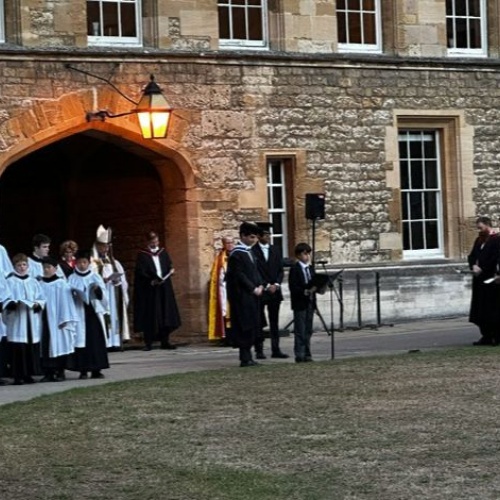
If you took one pupil from each cohort of NCS’s history, then lined them all up shoulder to shoulder, you would end up with a row about two and a half football pitches long.
It is quite a fun thought experiment, to consider whether the pupils at one end would, fundamentally, look pretty similar to those at the other. The clothing and, perhaps, some of the haircuts would be different, but the essentials would be pretty much the same. We have welcomed the 647th cohort of NCS pupils to the New College foundation, as they join the very long line of those who have come before them.
They were formally welcomed by our new Warden and Chair of Governors, Sir Robin Niblett, who also found himself in the rather odd situation that he was also, technically, welcoming himself. He formally took up the role of Warden on 1 September, but our Welcome to the Foundation service was his first formal duty vis a vis the school. Alongside welcoming new boys and colleagues (and, kind of, himself) in a bit of Latin, he spoke about the integral position that the school holds within the New College foundation, and his commitment to the place as Chair of Governors as well as Warden. He noted that the Welcome to the Foundation service came just a day before his formal installation as Warden by the Bishop of Winchester – the school, the Warden observed, came first.
Sir Robin is the forty-seventh Warden of New College since its foundation, so we have had a new one on average every thirteen years or so. With such a long history, New College has had the benefit of accumulating wisdom about what works when it comes to education, and what doesn’t. It has been in the position to eschew short-term fads, to embrace innovation when it has been worthwhile, but to reject superficially attractive changes which then turn out not to be very attractive after all. I would like to think that the school, nestled under the college’s wing, has been able to enjoy a similar approach over the decades and centuries. Looking to the future will always be important, and institutions’ long histories should be used to promote cautious wisdom, and not to suffocate their current custodians in aspic.
We have had nineteen Secretaries of State for Education since the turn of the millennium, so on average their time in office has not even reached a year and a half. With such a rapid turnover it is virtually impossible for them to survey the scene, identify worthwhile changes, work out how to resource those reforms, and implement them successfully. That is not a party political point, as the rate of turnover has been a feature of all governments since 2000. But sometimes taking the long view, judiciously seeing what works (and therefore should stay) and doesn’t (and therefore should go), is a much better way of going about things than rapid change, superficially attractive changes, and then a chorus of ‘oops’ at the end of it all. Because the ones who suffer, in the end, are the children discombobulated by the rate of change, especially if that change ends up having been rather pointless or detrimental. So I hope the school’s long sense of its history was underlined and appreciated in our Welcome to the Foundation service: a history that guides us sensibly, gives us the endorsement of longevity, and reminds us that true education cannot and must not be at the mercy of short-termist initiatives.